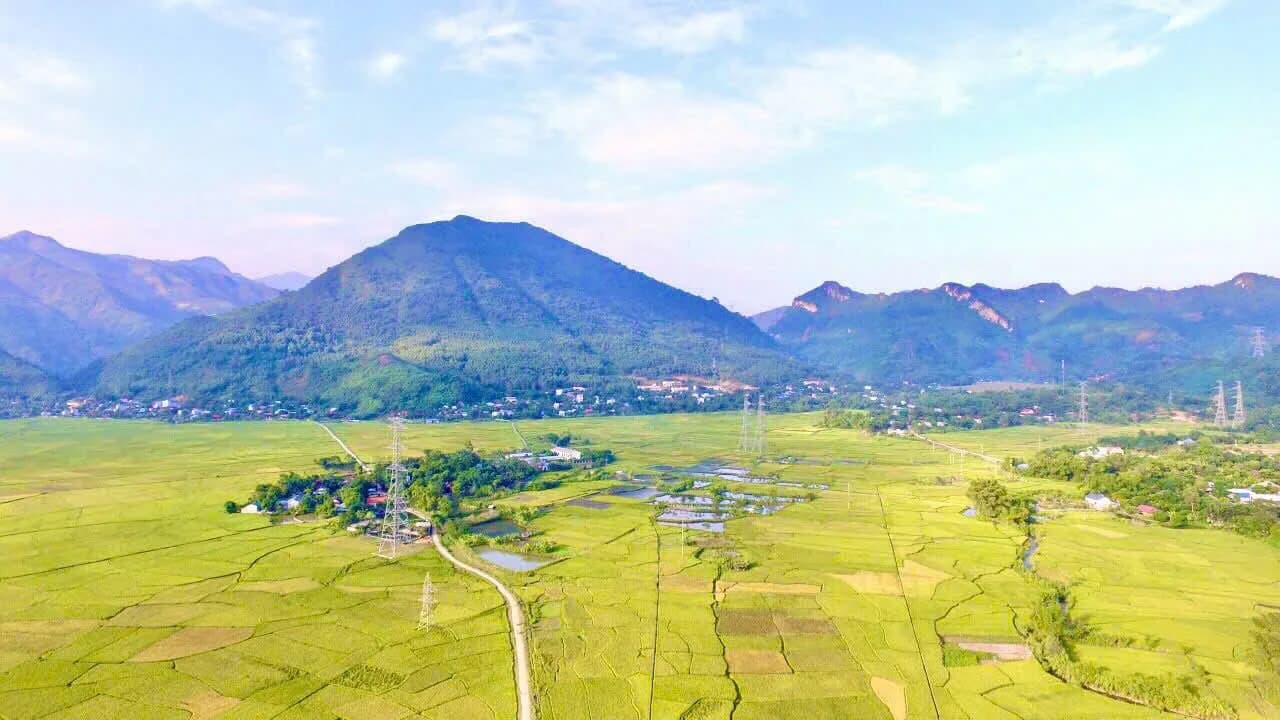
Mường Tấc Rice: The Jewel Grain Born in the Heart of the Phù Hoa Basin
Some places do not need to speak up. The land tells its story through the grain.
Mường Tấc is one such place. Set inside a wind-sheltered alluvial basin among the mountains of the Northwest, this field has fed people for generations, long before anyone thought to call it a "specialty". The Thai and Mường people here still plant by the old rhythm: waiting for the water of the Tấc stream to arrive, waiting for the mist to settle, waiting for the sun to rise. Unhurried as it is, it has grown into one of the four largest rice basins in the whole Northwest.
In this article I tell the whole story of Mường Tấc rice: where it comes from, why it tastes so good, which varieties are grown, how it is farmed, and how to recognise genuine grain in a market full of blurred claims.
1. What is Mường Tấc rice?
Mường Tấc rice is rice grown on the Mường Tấc field, a wet-rice valley along the Tấc stream basin in Phù Yên commune, Sơn La province. (Before 1 July 2025 this area belonged to Phù Yên district. When the country moved to two-tier local government the district level ceased to exist, and Quang Huy town together with the communes of Huy Hạ, Huy Tường, Huy Tân and Huy Thượng were merged into Phù Yên commune.)
The field spans more than 1,600 ha of natural area. Because it is farmed twice a year, the total sown area of paddy across the region reaches over 4,650 ha per year. That scale is large enough for Mường Tấc to rank as a true rice basin, not just a village field.
Northwest Vietnam has an old saying, handed down for generations, that ranks the four largest basin fields of the region:
"Nhất Thanh, nhì Lò, tam Than, tứ Tấc"
First Thanh, second Lò, third Than, fourth Tấc.
First is Mường Thanh (Điện Biên). Second is Mường Lò (in the former Yên Bái province). Third is Mường Than (Lai Châu). And fourth is Mường Tấc, here in Sơn La.
To rank fourth among the four rice basins of such a large mountain region is no small thing. The saying is a ranking made by local people themselves over hundreds of years of observation, long before any statistics existed.
To read more about this saying and the land of Phù Hoa, see the story of the Mường Tấc field and the land of Phù Hoa (in Vietnamese).
2. Why is Mường Tấc rice so good? Four conditions of the land
A grain of rice is not delicious by accident. It is the sum of very specific conditions, and Mường Tấc has all four.
2.1. Alluvial soil, continuously built up by the Tấc stream
The soil of the field is mostly old alluvium mixed with new alluvium, laid down season after season by the Tấc stream. This soil is rich in humus and trace minerals, which is what the rice plant needs to build aroma and store starch, not merely to grow fast.
The Tấc is the largest stream in the area. It runs through a string of villages that grow wet rice before flowing into the Đà River. All along that course the stream is both a source of irrigation and a source of fresh silt.
2.2. A wind-sheltered basin with its own microclimate
Mường Tấc is a valley almost fully enclosed by high mountain ranges. The basin shape has two important consequences.
First, nutrients are not washed away. Silt and humus collect inside the basin instead of flowing out to the big river.
Second, the gap between day and night temperatures is large. By day the mountain sun is fierce, so the rice plant photosynthesises hard and stores sugar. At night the temperature drops sharply, the plant breathes more slowly and keeps most of the sugar it has stored. This difference makes the grain plumper, more tender and gives a clearer sweet finish than rice grown in uniformly hot regions.
This is also the principle that explains why so many of Vietnam's best farm products come from the highlands.
2.3. Water from the forest, never passing through industrial areas
Irrigation water comes from the Tấc stream and from natural reservoirs in the area, including Suối Chiếu lake. The water runs down from forested mountain slopes, carrying natural nutrients, and more importantly it passes through no industrial zone before reaching the fields.
For a growing area aiming at organic standards, clean water from the headwaters is a condition that technique can hardly replace.
2.4. A long tradition of wet-rice farming by the Thai people
The Thai are among the most skilled wet-rice farming communities in the Northwest. In Mường Tấc they have worked paddy fields for many generations, and they know every plot, every flow of water, every sign of sky and earth.
That foundation explains why, when modern ecological farming methods were brought here, local farmers took them up quickly: sparse planting, border-row planting, composting organic fertiliser. In essence these are closer to the old ways than to the chemical farming of the last few decades.
3. The rice varieties grown on the Mường Tấc field
This is the part many buyers skip, yet it directly decides whether the rice in your bowl turns out tender or dry, fragrant or flat.
At present the Mường Tấc field grows three high-quality non-glutinous varieties commercially.
J02, a Japanese Japonica rice
- Origin: a pure-line Japonica variety of Japanese origin, introduced and selected by the Agricultural Genetics Institute.
- Plant: stiff stem that resists lodging well and tolerates cold well, which suits the winter of the northern mountains. Yield is about 6.5-7.5 tonnes/ha.
- Grain: slightly round, translucent white when milled.
- Cooked rice: tender and slightly sticky, with a deep sweetness. Cold J02 rice stays soft and does not turn hard and dry.
J02 is the variety GẠO ĐẠI MỘC, Mường Tấc has chosen as its main line. To understand this variety more deeply, see What is J02 rice and why it suits the soil of Mường Tấc (in Vietnamese).
BC15
- A high-quality pure-line variety that tillers strongly and regenerates well, with a steady yield of 6.0-8.0 tonnes/ha.
- Slender grain, with a high husked-rice (brown rice) recovery rate.
- Soft cooked rice with a light fragrance that stays tender when cold.
Đài Thơm 8
- Short growing period, fairly resistant to pests and disease, yield 6.0-7.0 tonnes/ha.
- Slender grain, bright and translucent.
- Glossy cooked rice, moderately sticky, with a distinctive fragrance.
Mường Tấc glutinous rice (Nếp Mường Tấc)
Besides the three non-glutinous varieties above, local farmers keep local glutinous rice varieties on special plots with plenty of water. Mường Tấc glutinous rice has large, plump grains. Steamed, the sticky rice comes out firm, rich, tender and fragrant. It is also the raw material for Mường Tấc cốm, young green rice flakes (in Vietnamese), a rustic country gift that few outside the region know.
One point to keep clear
Many people confuse Mường Tấc glutinous rice (Phù Yên) with Tan Mường Và glutinous rice. They are two different things, even though both come from Sơn La province:
| Mường Tấc glutinous rice | Tan Mường Và glutinous rice | |
|---|---|---|
| Growing area | Mường Tấc field, Phù Yên commune | Mường Và field, Sốp Cộp area |
| Growing period | An ordinary seasonal crop | Long, about 6-7 months |
| Standing | Traditional specialty of the Mường Tấc area | A specialty of the Sốp Cộp area alone |
Both are precious. But calling each by its right name is the least we can do to honour the people who grow them.
4. The biggest transformation: from chemicals back to organic
This is the part I most want to tell in detail, because it is the reason Mường Tấc rice today differs from Mường Tấc rice ten years ago.
The old story: tired soil
Before 2019 the Mường Tấc field took the path that many Vietnamese rice regions have taken: raising output with inorganic fertiliser and chemical plant-protection products.
Output did rise. But the soil began to lose its colour and life. Plankton, shrimp and fish at the foot of the fields thinned out and then disappeared. The field ecosystem lost its balance and pests broke out abnormally. The more they broke out, the more spraying was needed, and the more spraying, the more tired the soil became. A vicious circle.
The first to suffer were the farmers who stood and sprayed. After them, the bowl of rice.
The new story: back to the source
In 2019-2020 the locality approved and rolled out the project "Support for developing rice production in the organic direction, linked along the value chain and tied to product sales".
The Quang Huy Agricultural Services Cooperative is the core of this conversion. It began very modestly: 30 ha with 60 households. Persuading farmers to drop chemical fertiliser was not easy, because in the first year the yield would surely fall short, and hunger does not wait.
But they persisted. And the soil answered.
Today the Quang Huy cooperative has 160 members and manages 126-130 ha of rice certified to organic standards. Counted across the whole area, land linked to rice production in the organic and safe direction has passed 520 ha, with more than 1,300 households taking part.
From 30 ha to over 520 ha in about six years. That is a figure of trust, not only of technique.
The organic farming process at Mường Tấc
Nutrition: inorganic fertiliser is removed completely, and 100% biological organic fertiliser is used under chain-linkage contracts.
Plant protection: chemical pesticides are banned outright. In their place come biological preparations, antagonistic microorganisms and integrated pest management (IPM).
Agronomy: the improved rice intensification system SRI is applied, with sparse planting and border-row planting. The field is airy, light reaches the base of the plants, fungal pressure falls and the plants tiller more strongly. Fewer seedlings are planted, and the harvest is no smaller.
Water: water from the Tấc stream is led through a canal system with settling and filtering basins, making sure no waste stream mixes in before it enters the fields.
The soil has answered
After a few seasons, what came back to the fields was more convincing than any report. The soil became loose and crumbly again. Earthworms returned. Plankton returned. Shrimp and stream fish came back to the foot of the fields. Natural predators of pests returned, and when they return the pests balance themselves out, with no need for spraying.
People call this ecological restoration. The farmers here put it more simply: the soil is well again.
For the full process, the certification and how to verify it, see Organic Mường Tấc rice: six years of a restored soil (in Vietnamese).
5. Verifying genuine rice: what to ask, what to check
Reputation without a fence sooner or later gets borrowed. The surest way is for the buyer to verify before buying:
- Ask the variety: J02, BC15 or Đài Thơm 8, and from which harvest.
- Ask where it is grown: the Mường Tấc valley, Phù Yên commune, Sơn La province.
- Check the packaging: the packing unit, the packing date and traceability information if there is any.
A genuine seller can answer all three without having to think.
6. Two harvests a year, and which one to buy
The Mường Tấc field is farmed steadily in two crops:
| Crop | Period | Harvest |
|---|---|---|
| Spring-Summer crop | February to June | Around June |
| Summer-Autumn / Main crop | July to November | Around October-November |
From my own experience, the best rice is new rice, within 2-3 months after harvest. The longer rice sits, the more it loses the natural oils in the bran, so the cooked rice turns bland and less tender, even though the grain still looks fine from outside.
So if you are buying to eat over a long period, ask about the harvest rather than only the expiry date. A decent shop can answer this at once.
How to store rice so that it keeps its fragrance longest is written up separately in cooking and storing Mường Tấc rice (in Vietnamese).
7. Mường Tấc is more than rice
The grain is at the centre, but around it lies a whole region of culture.
The land of Phù Hoa. Old Mường Tấc belonged to a land called Phù Hoa, meaning a fertile, prosperous region. It is the long-settled home of the Thai, Mường and Dao peoples. The folk saying "Cơm Mường Va, cá suối Tấc" (rice of Mường Va, fish of the Tấc stream) has long been part of the cuisine of the region.
Bản Nhọt forest. In Gia Phù commune stands the historic site of Bản Nhọt forest, where General Võ Nguyên Giáp and his troops stopped on the march to the Điện Biên Phủ campaign in 1954. The rice of this region once fed those marching to war.
Mường Tấc leaf-yeast rice wine. The Tây Bắc Eco cooperative in Gia Phù brews rice wine with traditional leaf yeast, using Mường Tấc rice and natural stream water. The product has reached the 3-star level of the OCOP (One Commune One Product) programme, with an output of about 10,000 litres a year.
Phù Yên garlic. Dried garlic and black garlic of Phù Yên are grown in rotation on the same Mường Tấc soil, a way of letting the land rest while still earning.
The ripening season. In June and in October-November the whole basin turns gold. Visitors who come to Bản Nhọt forest or Suối Chiếu lake at the right time will meet a very different Northwest: not grandly fierce, but peaceful and abundant.
8. Recognising genuine Mường Tấc rice
Because the name has risen, rice from elsewhere wearing the Mường Tấc name is a real thing. A few signs you can check yourself:
They can name the variety. A genuine seller answers at once: J02, BC15 or Đài Thơm 8. A seller borrowing the name usually answers vaguely, "fragrant, tender Northwest rice".
They can name the harvest. Rice has a crop. The answer should be "the October crop just past", not "new stock just arrived".
The traceability code scans. Proper packaging carries a QR code leading to the real growing area and the real packing unit, not to a generic home page.
Look at the grain. J02 is slightly round, translucent white and even. If a bag sold as J02 holds slender, long grains, it is another variety.
Beware of prices that are too low. Organic Phù Yên rice sells at an average of about 25,000 VND/kg at the time of the survey. The real cost of organic farming (biological fertiliser, labour for sparse planting, hand weeding) does not allow prices much lower. A bag of "organic Mường Tấc rice" at 15,000 VND/kg means something is not right.
For more detail on choosing and on genuine sales channels, see where to buy genuine Mường Tấc rice (in Vietnamese).
9. GẠO ĐẠI MỘC, from Mường Tấc
Allow me a short aside of my own.
On 26 June 2026, at the end of the harvest on the sixth-year organic rice field at Mường Tấc, in a conversation with the calligrapher Thiền Phong (Phạm Văn Tuấn), the name ĐẠI MỘC GẠO was born, written in Hán-Nôm brushwork on a mounted scroll.
Master Thiền Phong explained its meaning:
- ĐẠI: in the greatest sense.
- MỘC: the nourishing grace of rain that heaven and earth send down to the human world, letting all things grow.
- GẠO: the grain that feeds people, a word written in pure Nôm script of the nation of Đại Việt.
"Ngọc thực của trời, ơn nhuần nơi đất."
Heaven's jewel of grain, grace that soaks into the earth.
That is why I do not call this a "rice product". I call it a Heritage Rice Plant (Cây Lúa Di Sản), one current in the flow Mạch Linh Di Sản → Cây Lúa Di Sản → Đại Mộc Gạo → Đại Việt Trà Hoa.
Every land has its own jewel. And for this first land:
"Ăn cơm có quê, gạo này từ quê Mường Tấc."
Rice with a hometown: this rice comes from the hometown of Mường Tấc.
Frequently asked questions
On the Mường Tấc field, along the Tấc stream basin, in Phù Yên commune, Sơn La province. Before 1 July 2025 this area belonged to Phù Yên district. Since the country moved to two-tier local government there is no district level any more.
Essentially they come from the same rice region. "Mường Tấc" is the popular name of the field, while "Phù Yên" is the place where the field lies. When buying, ask about the variety and where it was grown rather than relying on the name alone.
Organic rice from the Mường Tấc area sold at an average of about 25,000 VND/kg at the time of the survey, a noticeable amount above ordinary rice. The actual price varies with the variety (J02, BC15 or Đài Thơm 8), the harvest and the sales channel, so when buying, ask about all three.
No. About 126-130 ha across the area is certified organic, and more than 520 ha is linked to production in the organic and safe direction, out of a total sown area of over 4,650 ha per year. So certified organic rice is only a part of the whole. When buying, ask about the certification.
The best rice is new rice, right after the two harvests of the Mường Tấc field: around June-August after the spring-summer crop and November-December after the main crop. Rice keeps its fragrance best in the first 2-3 months after harvest, so when buying, ask about the harvest rather than only the expiry date.
Not at all. It needs slightly less water than ordinary non-glutinous rice because J02 grains are round and naturally sticky. A reference ratio is about 1 part rice to 1.1-1.2 parts water, adjusted to how fresh the rice is. Cold J02 rice stays tender. Cooking and storage are written up in a separate guide (in Vietnamese).

Heaven's jewel of grain, grace that soaks into the earth.
Rice with a hometown: this rice comes from Mường Tấc.
GẠO ĐẠI MỘC, MƯỜNG TẤC